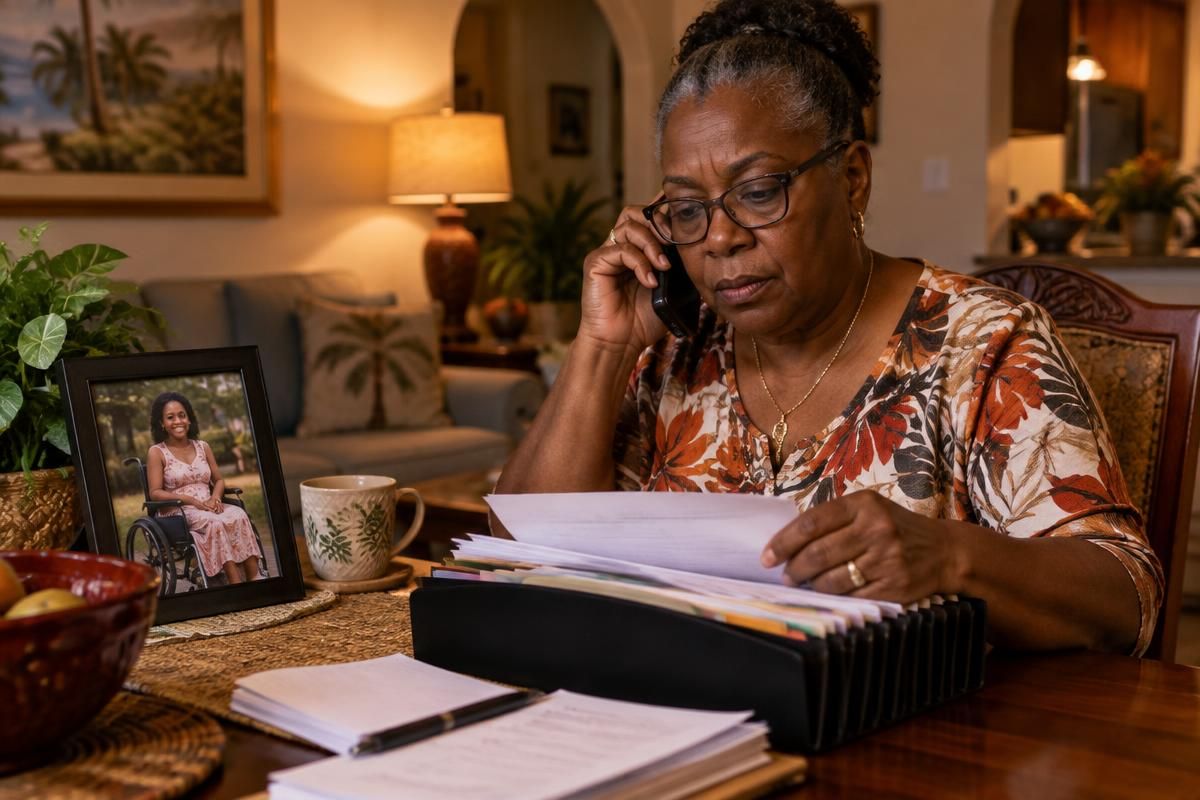
Antoinette gets this phone call more often than you'd think.
A woman calls from a few states away. Her brother passed recently. For twenty-some years he handled everything for his daughter, who has cerebral palsy, a G-tube, and seizures. While he was sick, the state helped place his daughter in a facility on the other side of Florida, because someone had to and nobody had time to shop around. Now the funeral is over. A judge has granted the aunt guardianship over Zoom. The paperwork hasn't shown up yet. And she wants her niece closer to family.
She has asked to have her moved. Repeatedly. Politely. Nothing is happening.
She isn't confused about what good care looks like. She's confused about who's in charge. Which is fair, because whoever designed this system did not have you in mind.
If that's you, breathe. This is fixable, and it's more common than it feels. Here's what Antoinette told her, roughly in the order it matters.
1. Ask who's paying
Not the facility. The program. Call the current provider and ask one question: "What program or agency covers her funding?"
In Florida, adults with developmental disabilities are usually funded through APD's iBudget waiver or through Medicaid's Long-Term Care program. Sometimes a person gets switched from one to the other during a hospital stay, and the family never really hears about it. The answer to this question decides who you call next.
Also: Medicare and Medicaid sound like the same thing. They are not. Nobody is grading you.
2. Ask for the paperwork with her name on it
If she's on the APD waiver, two documents exist: her support plan and her QSI, the assessment that sets her level of support. Ask for copies of both. The support plan lists the name and phone number of the person you actually need, which brings us to the next step.
3. Find the person whose job is you
The aunt asked, "Don't I get a case manager or somebody?" Yes. You do.
On the APD waiver, that's a waiver support coordinator. On another program, there's still a case manager. Their job is to lay out your loved one's options and act on what you decide. The facility director is not that person. A provider can be lovely and still not be the one who decides where your loved one lives.
4. Push the guardianship papers
Officially, APD won't discuss your loved one's file until you can prove you're the guardian. Unofficially, this is a system run by people. Be warm, be clear about what you need, ask good questions, and follow up like it's your job. Doors open earlier than the rulebook says more often than you'd think.
Meanwhile, call the court, call your attorney, and be polite and a little annoying about those papers.
Once you have them, things speed up. You can go straight to APD, say what you want, and start the move.
Reading this because you are trying to work something out for someone you love? You can tell us about them at the bottom of this page. A real person reads every inquiry.
5. Know that you can switch back
If your loved one was moved off the APD waiver onto Long-Term Care, adults can generally move back. It takes time and a few phone calls. There is also a newer route: since July 2026, adults with developmental disabilities on Long-Term Care can choose ICMC, a managed care program that does cover group homes. If those letters mean nothing to you yet, we wrote a plain-English guide to them.
We help families through exactly this kind of switch. It's a normal week for us, even if it's the worst month of your life.
How she found us (and a confession)
She found us by watching a talk Antoinette gave at Family Cafe about what to look for in a medical group home. She said it answered questions nobody else had. Then she called.
We'd love to say our marketing is that clever. Mostly it's Antoinette being blunt on camera for an hour.
Closer is allowed
One more thing she needed to hear: moving your loved one closer now doesn't lock you in. If something even closer to home turns up later, that's your call. We want your loved one where your family can actually show up. Nobody is getting kidnapped.
If you're in the middle of this, call us at (689) 777-2892. Even if we're not the right fit, we'll tell you who to call next. And if your loved one is aging out of pediatric care rather than moving after a loss, start with our guide for families given very little notice.
For support coordinators and case managers
If you're working a relocation like this one, we're glad to help the family from our side of the process. See our referral information.
Frequently Asked Questions
Will APD talk to me before my guardianship papers arrive?
Officially, APD waits until you can prove guardianship. In practice, clear requests and steady follow-up often move things sooner, so push the court for your papers while you make contact.
What documents should I request if my loved one is on the APD waiver?
Ask for the support plan and the QSI assessment. The support plan also lists the name and phone number of the waiver support coordinator.
Can an adult who was moved to Long-Term Care go back to the APD waiver?
Adults can generally move back, though it takes time. Since July 2026, adults with developmental disabilities on Long-Term Care can also choose ICMC, which covers group homes.
Related Articles
Explore More Resources
Tell Us About Your Loved One
Share where things stand and a member of our team will review your inquiry and reach out promptly.
🌐 Our team speaks English, Spanish, Haitian Creole, and Portuguese. We're here to help your family in the language you feel most comfortable with.
Get in Touch
Fields marked with * are required.